
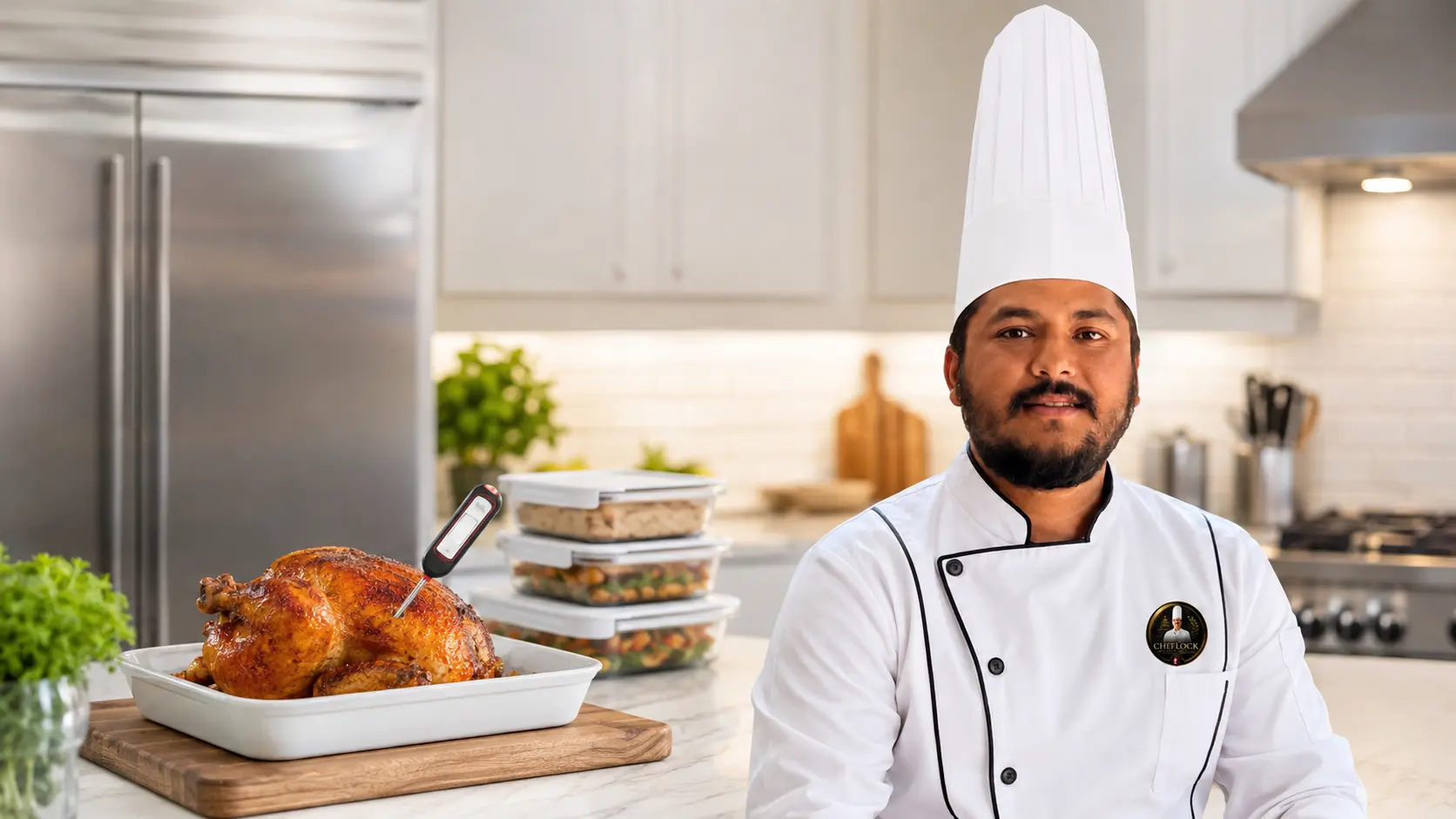
Chicken is versatile, but safe results require more than looking for clear juices or a particular colour. Use clean separation, controlled thawing, a food thermometer and prompt refrigeration. The guidance below is written for home cooks and should be used together with the food-safety advice of your local authority.
Keep raw chicken separate
Store raw chicken in a sealed container on the lowest practical refrigerator shelf so juices cannot drip onto ready-to-eat food. Use a separate board when possible. If equipment has touched raw chicken, wash it with hot soapy water before it touches cooked food, salad, herbs or serving utensils.
Do not wash raw chicken
Rinsing poultry can spread contaminated droplets around the sink, counter and nearby utensils. Cooking—not washing—is the control step. Move chicken carefully from its package to the preparation area, then clean and sanitise contacted surfaces.
Thaw chicken safely
USDA recognises three safe methods:
- Refrigerator: the safest and easiest method to control. Place the chicken in a container to catch liquid.
- Cold water: keep it in leak-proof packaging, submerge in cold water and change the water regularly. Cook promptly after thawing.
- Microwave: use only when you will cook the chicken immediately, because some areas may begin to warm or cook.
Never thaw chicken on the counter. The surface can warm into a range where bacteria multiply while the centre remains frozen.
Cook to a measured internal temperature
All poultry should reach a safe minimum internal temperature of 74°C / 165°F, measured with a clean food thermometer. Insert the probe into the thickest part without touching bone. For a whole bird, check more than one area, including the innermost thigh and thickest breast.
Colour is not a reliable safety test. Properly cooked chicken can sometimes remain slightly pink, while over-browned chicken can still be undercooked in the centre.
Avoid cross-contamination after cooking
- Move cooked chicken to a clean plate, not the raw-chicken plate.
- Use clean tongs or wash the utensils used during raw handling.
- Do not brush cooked chicken with a raw marinade unless the marinade has been brought to a safe boil.
- Wash hands with soap and water for at least 20 seconds before and after raw poultry handling.
Cool and refrigerate promptly
Refrigerate perishable cooked food within two hours, or within one hour when the surrounding temperature is above 32°C / 90°F. Divide large quantities into shallow containers so they cool faster. Keep the refrigerator at 4°C / 40°F or below.
How long to keep chicken
- Raw chicken in the refrigerator: generally 1–2 days.
- Cooked chicken or leftovers: generally 3–4 days.
- Frozen storage: freezing keeps food safe while continuously frozen, although quality changes over time.
When you cannot confirm how long food has been warm or refrigerated, do not use tasting as a safety test.
Reheat leftovers correctly
Reheat chicken leftovers to 74°C / 165°F. Cover and rotate food in the microwave so cold spots are reduced. Reheat only the portion you plan to eat, and keep the rest chilled.
A simple safe workflow
- Plan thawing in the refrigerator.
- Prepare salad and ready-to-eat ingredients first.
- Handle raw chicken in a clearly separated area.
- Wash hands and contacted tools.
- Cook and verify 74°C / 165°F with a thermometer.
- Serve on clean equipment.
- Refrigerate leftovers promptly in shallow containers.
Official food-safety references
- USDA FSIS: Chicken from Farm to Table
- USDA FSIS: Safe Minimum Internal Temperature Chart
- FDA: Safe Food Handling
- FoodSafety.gov: Cold Food Storage Chart
Cook with the method as well as the safety controls: browse the ChefLock recipe collection.