
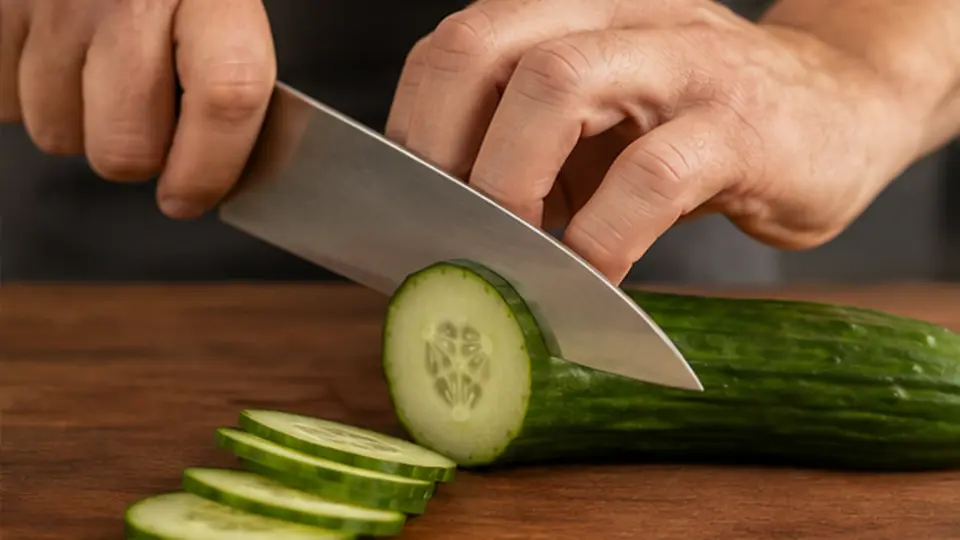
Lesson 12: Knife safety begins with body position and control. The knife hand guides the blade while the other hand creates a repeatable guide that keeps fingertips away from the edge.
What You Will Learn
- Use a controlled pinch grip.
- Form a stable claw with the guiding hand.
- Set board height, stance and movement for efficient cutting.
Why This Matters in a Professional Kitchen
Good mechanics reduce slips and produce consistent pieces that cook evenly. They also protect the wrist, shoulder and back during repetitive preparation.
The pinch grip controls the blade
Pinch the blade gently near the handle with thumb and index finger while the remaining fingers wrap the handle. Avoid a rigid squeeze; control comes from secure contact and a relaxed wrist, not excessive force.
The claw creates a moving guide
Curl fingertips behind the first knuckles and rest the blade lightly against the flat knuckle surface. Move the guiding hand backward in small steps, keeping the thumb tucked and never reaching in front of the edge.
Posture controls the whole system
Stabilise the board, stand balanced with the work slightly to one side and keep the cutting zone below a comfortable elbow position. Let the blade do the work and pause whenever the ingredient becomes unstable.
ChefLock Professional Method
- Place a damp towel or approved mat under a flat cutting board.
- Stand balanced and create a clear cutting zone.
- Form the pinch grip before touching the ingredient.
- Make a stable flat surface on round ingredients.
- Set the claw and begin slowly with the blade path visible.
- Stop, place the knife down safely and reset whenever control is lost.
Common Mistakes and Corrections
Pointing the guiding fingertips toward the blade
Correction: Curl them behind the knuckles and keep the thumb tucked.
Gripping the handle with one tight fist
Correction: Use a relaxed pinch grip for finer steering and less fatigue.
Chasing a rolling ingredient
Correction: Create a flat base before continuing and never catch falling food with the knife hand.
Practice Drill
Practise on a cucumber at half speed. Cut ten equal slices, pause and inspect thickness, then repeat without increasing speed until the board, grip, claw and posture remain stable. Accuracy must improve before tempo.
Service-Ready Checklist
- Board cannot slide.
- Ingredient has a stable base.
- Pinch grip is secure but relaxed.
- Fingertips and thumb remain behind the knuckles.
- Blade is placed down safely before interruptions.
Chef’s Note
Speed is permission earned by consistent control; it should never be the first target.
Key Takeaway
A stable board, relaxed pinch grip and disciplined claw turn knife work into a controlled repeatable motion.
This lesson provides general culinary education. Follow local food-safety rules, workplace procedures and the manufacturer’s instructions for your equipment.