
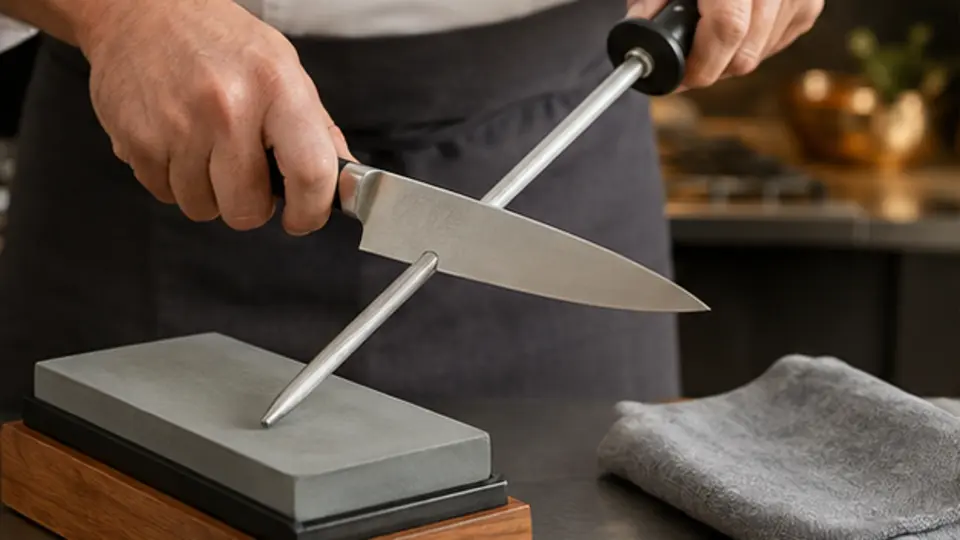
Lesson 13: A dull knife demands more force and is harder to steer. Edge maintenance is therefore a safety and quality task, not a cosmetic ritual.
What You Will Learn
- Distinguish honing, sharpening and repair.
- Use a honing steel with a controlled angle.
- Test, clean and store an edge safely.
Why This Matters in a Professional Kitchen
Correct maintenance extends knife life and keeps cuts clean. Incorrect angles, aggressive grinding or careless storage can permanently change the blade and create new hazards.
Honing realigns; sharpening removes metal
A suitable honing rod can refresh a slightly rolled working edge, but it cannot rebuild a truly blunt or damaged bevel. Sharpening stones or machines remove metal to form a new apex and require more precision.
Consistency matters more than dramatic movement
Use the angle appropriate to the knife, light pressure and the same number of strokes on both sides. A stable rod or stone and slow full-edge contact are safer than fast airborne strokes.
Edge tests should be controlled
Inspect under light and use paper or a soft food test without touching or sliding a finger along the edge. Wash away metal residue, dry completely and protect the blade in suitable storage.
ChefLock Professional Method
- Inspect the edge for chips, bends and handle damage.
- Confirm the steel and recommended edge angle.
- Stabilise the honing rod or stone on a non-slip surface.
- Work from heel to tip with light even strokes on alternating sides.
- Test carefully and repeat only as needed.
- Wash, dry, record damage and store the knife with the edge protected.
Common Mistakes and Corrections
Honing a chipped blade harder
Correction: Stop and send significant damage for suitable repair; honing cannot replace missing steel.
Changing the angle on every stroke
Correction: Slow down and use a visual or physical guide until the motion is repeatable.
Storing loose knives in a drawer
Correction: Use a clean rack, sheath or roll that protects both the edge and anyone reaching nearby.
Practice Drill
Mark the bevel of a training knife with a removable marker, then make a few supervised stone strokes. Inspect where the marker was removed to understand angle contact. Finish with a safe paper test and compare the result with the starting edge.
Service-Ready Checklist
- Knife inspected before maintenance.
- Correct tool selected for the steel and condition.
- Stable surface and controlled angle used.
- Metal residue washed away and blade dried.
- Knife stored with protected edge.
Chef’s Note
An edge maintained little and often is safer and lasts longer than an edge rescued aggressively after neglect.
Key Takeaway
Hone for minor alignment, sharpen when the bevel is blunt and seek repair when the blade is damaged.
This lesson provides general culinary education. Follow local food-safety rules, workplace procedures and the manufacturer’s instructions for your equipment.