
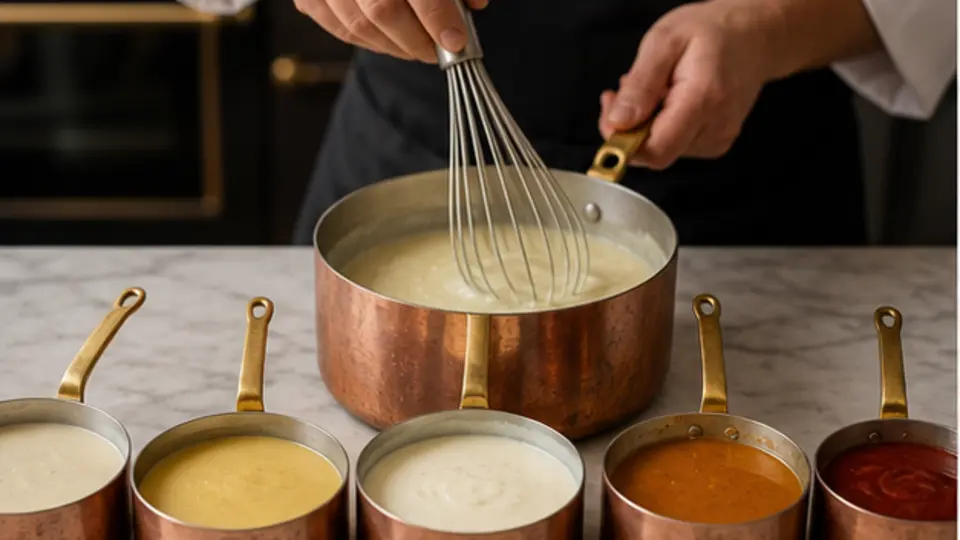
Lesson 35: The classical mother sauces are useful not as a list to memorise, but as five systems for thickening, reducing, emulsifying and building flavour.
What You Will Learn
- Identify the structure of five classical sauce families.
- Match thickening method to the desired finish.
- Adapt a base sauce without losing balance or texture.
Why This Matters in a Professional Kitchen
Modern kitchens may use lighter stocks, vegetable bases or dietary alternatives, yet the underlying control of starch, liquid, heat and fat still applies.
Roux sauces require cooked starch and gradual liquid
Béchamel and velouté use a roux with milk or light stock. Cook flour sufficiently for the intended colour, add liquid in controlled stages and simmer long enough to remove raw starch flavour.
Brown and tomato sauces build through concentration
Espagnole-style sauces develop roasted notes and reduction, while tomato sauces balance natural acidity, sweetness and texture. Neither improves through uncontrolled burning or excessive thickener.
Hollandaise is a warm emulsion
Egg yolk and clarified butter need gentle temperature and steady addition. The sauce should be held only through an approved safe service plan; it is not a sauce to leave warm indefinitely.
ChefLock Professional Method
- Define the desired sauce body, colour and main flavour.
- Choose the appropriate base and thickening system.
- Prepare aromatics, roux, reduction or emulsion in controlled stages.
- Add liquid or fat gradually while maintaining the required heat.
- Cook out, strain or blend according to the style.
- Adjust seasoning, consistency and holding only after the structure is stable.
Common Mistakes and Corrections
Using roux to repair every thin sauce
Correction: First decide whether reduction, puree, emulsion or a lighter texture suits the dish.
Serving a floury béchamel
Correction: Simmer sufficiently while stirring and assess taste as well as thickness.
Overheating hollandaise
Correction: Control bowl and butter temperature and remove from heat before yolk curdles.
Practice Drill
Prepare small samples of one roux-thickened sauce, one reduced tomato sauce and one emulsion. For each, identify the continuous liquid, thickening mechanism, main failure risk and one modern menu application.
Service-Ready Checklist
- Sauce family suits the dish.
- Starch, reduction or emulsion controlled.
- Raw flour or harsh acidity cooked out.
- Texture coats or flows as intended.
- Holding method protects safety and quality.
Chef’s Note
Tradition becomes useful when you understand the method well enough to adapt it intelligently.
Key Takeaway
Mother sauces teach transferable systems for building body, flavour and stability across modern cooking.
This lesson provides general culinary education. Follow local food-safety rules, workplace procedures and the manufacturer’s instructions for your equipment.