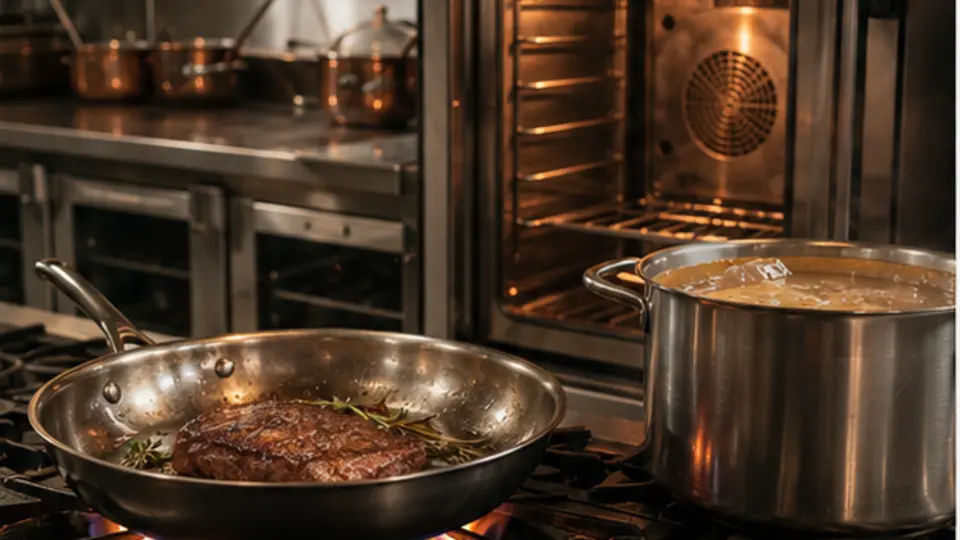
Lesson 21: Heat does not enter every food in the same way. Pan contact, moving air or liquid, and radiant energy create different rates of browning and internal cooking.
What You Will Learn
- Distinguish conduction, convection and radiation.
- Explain how thickness, moisture and starting temperature affect cooking.
- Select equipment and heat level for the intended result.
Why This Matters in a Professional Kitchen
When chefs understand heat transfer, they can diagnose an undercooked centre, pale roast or burnt surface instead of changing time and temperature randomly.
Conduction needs contact
A hot pan transfers energy directly into food where the surfaces touch. Flat contact, suitable preheating and controlled moisture support even browning; warped pans and crowded wet food create weak or uneven contact.
Convection moves heat through fluid
Water, oil and circulating oven air carry heat around food. Movement can improve evenness, but the medium’s temperature and the food’s size still control how quickly the centre changes.
Radiation acts across space
Grills, broilers and glowing elements transfer strong surface energy without direct contact. Distance matters, so the chef must watch colour while allowing conduction to move heat toward the centre.
ChefLock Professional Method
- Define the desired surface colour and internal doneness.
- Identify the main heat-transfer method of the equipment.
- Choose food thickness, pan or vessel and starting condition.
- Preheat or temper only when the recipe and safety plan allow.
- Observe surface cues and verify the centre appropriately.
- Adjust one variable at a time and record the effect.
Common Mistakes and Corrections
Increasing heat when the centre is still raw
Correction: Consider thickness and reduce surface intensity so heat has time to travel inward.
Crowding a pan and blaming the burner
Correction: Cook in batches so released moisture can escape and pan contact recovers.
Assuming every oven heats identically
Correction: Use an oven thermometer or known test, rotate when appropriate and learn the equipment’s airflow.
Practice Drill
Cook equal pieces of one vegetable by pan contact, simmering and oven roasting. Record time, colour, moisture and texture. Explain which heat-transfer methods dominated and why the outcomes differ.
Service-Ready Checklist
- Target surface and centre defined.
- Food thickness consistent.
- Equipment preheated appropriately.
- Pan or oven not overcrowded.
- Doneness checked with a suitable cue or tool.
Chef’s Note
Time and temperature make more sense when you first ask how the heat can physically reach the food.
Key Takeaway
Control cooking by matching the heat-transfer method, food structure and desired finish.
This lesson provides general culinary education. Follow local food-safety rules, workplace procedures and the manufacturer’s instructions for your equipment.