
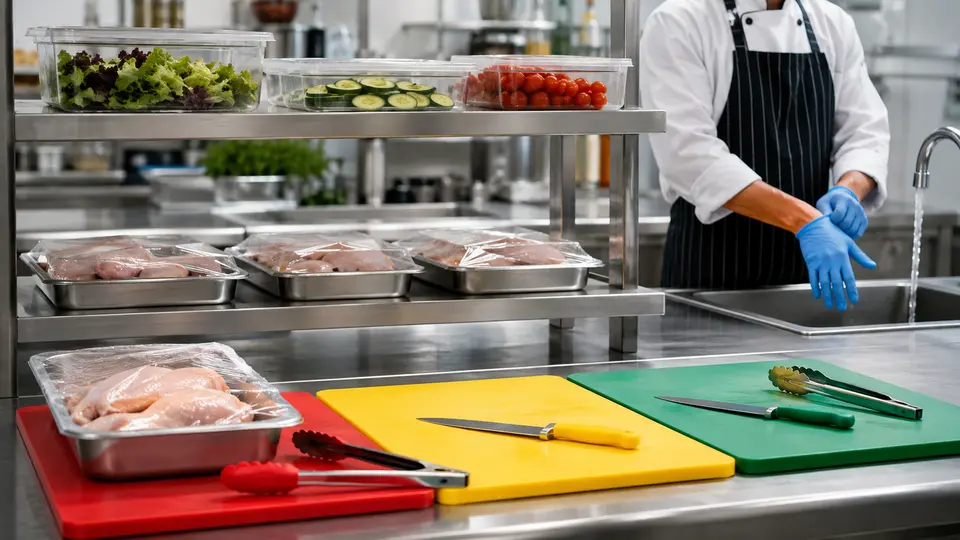
Lesson 5: Cross-contamination happens when a hazard moves from one ingredient, person, tool or surface to another. Allergen management requires the same disciplined thinking with an additional rule: never promise safety unless the kitchen can genuinely control the risk.
What You Will Learn
- Recognise common routes of microbial and allergen cross-contact.
- Set up a separated workflow for a special dietary order.
- Communicate limitations honestly and escalate uncertainty.
Why This Matters in a Professional Kitchen
For a guest with a food allergy, a trace amount can matter. The whole path—from the order and ingredient label to the final plate—must stay accurate, separated and clearly communicated.
Separation is more than colour-coded boards
Dedicated tools help, but hands, aprons, cloths, fryer oil, grills, tongs, storage drips and garnish containers can still transfer hazards. Think about every contact point and arrange work from clean tasks toward raw or higher-risk tasks.
Allergen information must be verified
Use current ingredient labels, approved recipes and supplier information. Never rely on memory, assume that a replacement brand is identical or remove a visible allergen and call the dish safe.
The order needs an unbroken communication chain
Repeat the requirement back, mark it through the approved ordering system, tell the responsible chef and identify the finished plate. If any link is uncertain, stop and clarify before cooking or serving.
ChefLock Professional Method
- Receive the dietary request and repeat it back in clear language.
- Check the current recipe, ingredient packaging and shared-equipment risks.
- Wash hands and change contaminated clothing or gloves.
- Clean and sanitise the workspace; collect clean dedicated utensils and containers.
- Prepare the order away from splashes, crumbs and shared garnishes.
- Keep the plate identified and hand it directly through the agreed service route.
Common Mistakes and Corrections
Picking nuts or cheese off a finished dish
Correction: Start again with verified ingredients and a clean process; removing the visible ingredient does not remove traces.
Using the same fryer for an allergen-free claim
Correction: Treat shared oil as a cross-contact risk and explain the limitation if no dedicated fryer exists.
Giving a confident answer from memory
Correction: Pause service and verify the label, recipe and kitchen procedure with the responsible person.
Practice Drill
Simulate an allergen order using coloured tokens instead of food. Place tokens on every hand, tool and surface that touches the normal dish, then design a special-order route that prevents the token from reaching the final plate. Debrief any hidden contact points with the team.
Service-Ready Checklist
- Request repeated back and recorded accurately.
- Every ingredient and substitution verified.
- Hands, station and dedicated tools clean.
- Shared oil, grills, steam and garnishes assessed.
- Finished plate identified and transferred without mix-up.
Chef’s Note
Never allow speed or embarrassment to turn uncertainty into a guess. A professional answer can be: “I need to check before I confirm.”
Key Takeaway
Safe allergen service depends on verified information, physical separation and clear communication from order to guest.
This lesson provides general culinary education. Follow local food-safety rules, workplace procedures and the manufacturer’s instructions for your equipment.