
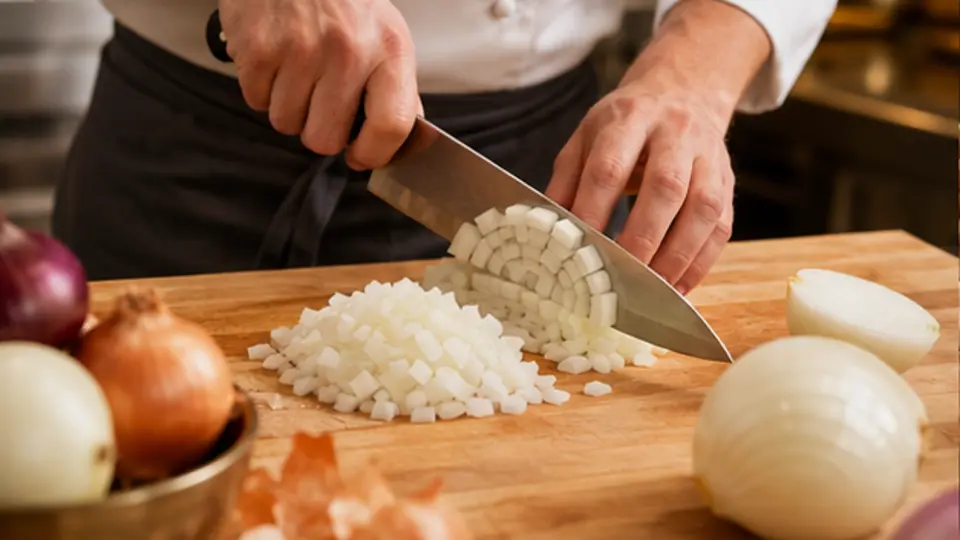
Lesson 15: Onions appear in countless preparations, so small improvements in method create major gains in speed, yield and consistency over a week of service.
What You Will Learn
- Prepare a stable onion with minimal trim.
- Produce even slices and dice using the root for control.
- Separate skins, clean trim and finished product safely.
Why This Matters in a Professional Kitchen
The root holds layers together during cutting, but soil and damaged outer layers must still be controlled. A sharp knife and organised batches reduce crushing, tears and unnecessary waste.
Keep structure until it has served its purpose
Remove the top, halve through the root and peel only the dry or damaged layers. Leaving the root end attached during most cuts keeps layers aligned; remove it cleanly at the end.
A sharp edge reduces crushing
Clean slices damage fewer cells than pressing with a dull blade. Work in a ventilated area, avoid rubbing the eyes and wash hands and tools after large batches.
Cut direction changes texture
Cuts across the onion’s natural lines behave differently from pole-to-pole slices. Select direction and thickness for quick sauces, caramelising, pickling or a visible garnish rather than using one cut for everything.
ChefLock Professional Method
- Inspect the onion and remove loose soil before the board.
- Cut the top, halve through the root and peel minimally.
- Place the flat face down and position the guiding hand.
- Make controlled horizontal and vertical cuts only when required by the target dice.
- Cut across at even intervals while the root holds the layers.
- Remove the root, check consistency and store the onion covered and labelled.
Common Mistakes and Corrections
Cutting off both ends before dicing
Correction: Retain the root temporarily so the layers remain together.
Using many horizontal cuts in a small onion
Correction: Avoid unnecessary risky cuts; natural layers already provide horizontal separation.
Peeling away thick usable layers
Correction: Remove only dry, dirty or damaged material and measure trim yield.
Practice Drill
Dice three onions using a measured target size. Time only after the first onion establishes safe technique. Weigh finished dice and trim, then cook a sample to check whether the pieces soften evenly.
Service-Ready Checklist
- Root retained until final cuts.
- Flat side stable on the board.
- Knife sharp and cuts controlled.
- Dice matches the recipe requirement.
- Finished onion covered, labelled and kept away from ready-to-eat garnish.
Chef’s Note
The fastest onion method is the one that gives a safe, usable batch without needing correction.
Key Takeaway
Use the onion’s natural structure to improve control, consistency and yield.
This lesson provides general culinary education. Follow local food-safety rules, workplace procedures and the manufacturer’s instructions for your equipment.