
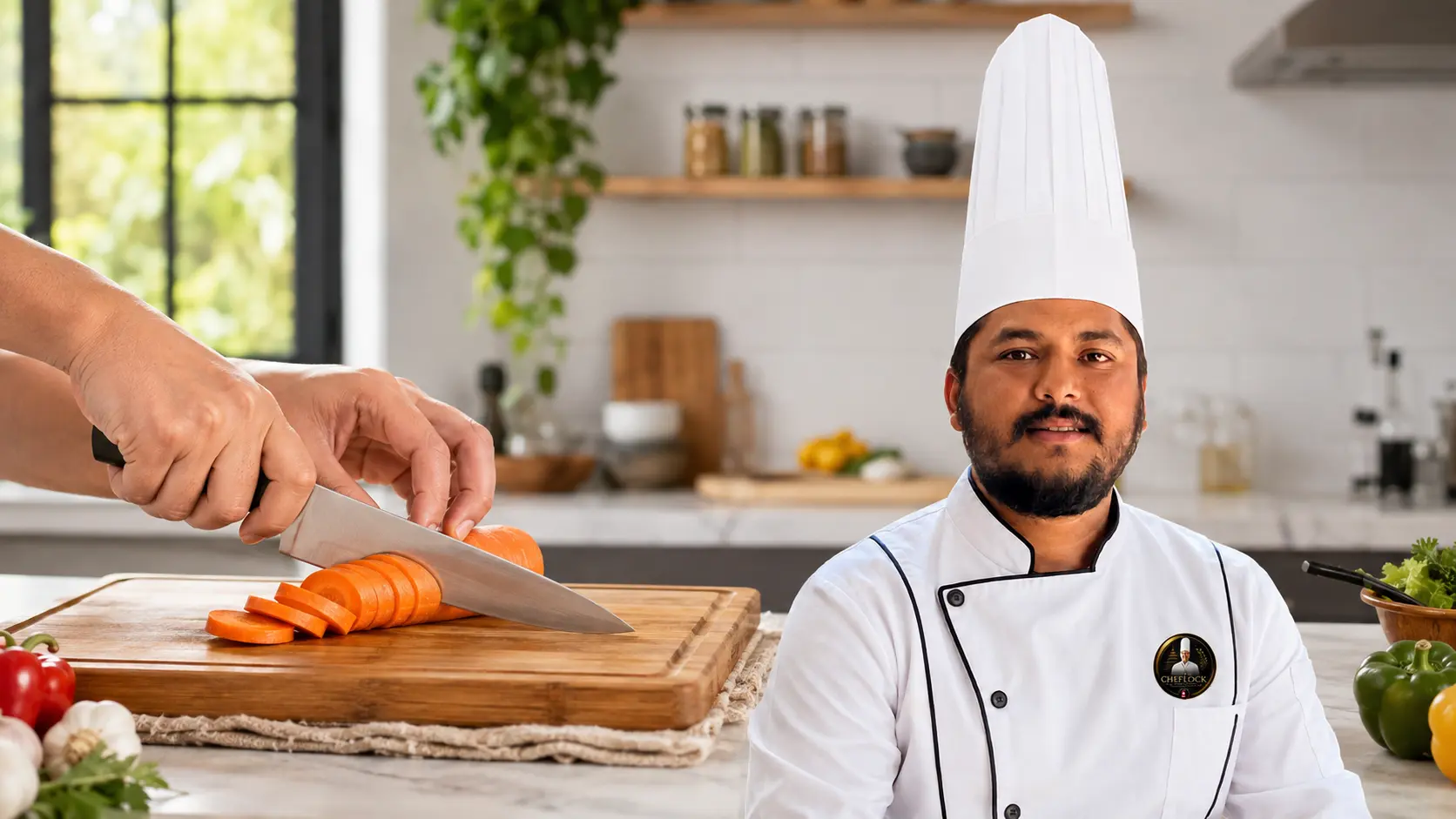
Knife skill is not speed. It is control, consistency and awareness. A home cook who works slowly with a stable board and a maintained knife is using a more professional technique than someone cutting quickly without control.
Set up the board safely
Place a damp towel or non-slip mat beneath the chopping board. The board should be large enough for the ingredient, the knife and a small area for finished cuts. Clear unrelated tools from the space and keep the floor dry.
Choose the right knife
A chef’s knife handles most vegetables, herbs and boneless proteins. A small paring knife is useful for controlled hand work, while a serrated knife suits bread and delicate-skinned produce. Do not force one knife to do every job, and never use a kitchen knife as a can opener or screwdriver.
Use a secure grip
Pinch the blade gently near the handle with thumb and forefinger, then wrap the remaining fingers around the handle. This gives better control than holding only the end of the handle. The grip should be firm but not tense.
Protect the guiding hand
Use a claw shape: curl fingertips inward and let the side of the blade move against the front knuckles. The thumb stays behind the fingers. Move the guiding hand backwards in small steps as the ingredient becomes shorter.
Learn the main cutting motion
Many chef’s knives work with a forward-and-down or gentle rocking motion. The knife should slice rather than crush. Keep the tip or a controlled part of the blade in contact with the board when appropriate, and avoid lifting the knife high above the ingredient.
Practise consistent cuts
Slice
Used for onion, cucumber, carrot and many fruits. Stabilise round ingredients by creating a flat side first.
Dice
Create even slabs, then sticks, then cubes. Consistency matters because equal pieces cook at the same rate.
Julienne
Cut thin, even matchsticks. Begin with a stable rectangular shape rather than chasing perfect cuts from a rolling vegetable.
Chiffonade
Stack broad herb leaves, roll them loosely and slice into ribbons without pressing so hard that they bruise.
Rough chop
Not every preparation needs precision. Stock vegetables and ingredients that will be blended can be cut more simply, as long as pieces cook evenly enough for the method.
Honing and sharpening are different
Honing realigns a fine edge; sharpening removes metal to create a new edge. A honing steel cannot repair every dull knife. Use a suitable sharpening system or a trusted professional service, and follow the tool manufacturer’s instructions.
Keep the knife clean and visible
- Wash the knife soon after use and dry it carefully.
- Do not leave it hidden in a sink of water.
- Place it flat in a visible safe area when paused.
- Carry it pointed down at your side in a professional kitchen, announcing your movement where appropriate.
- Store it in a block, sheath or magnetic holder that protects the edge.
A ten-minute practice routine
- Stabilise the board.
- Practise the grip with the knife still.
- Create a flat side on one carrot or potato.
- Cut slow, even slices.
- Stack safely and make sticks.
- Turn the sticks and make a dice.
- Stop when control decreases—speed is not the goal.
Common mistakes
Do not cut towards your palm, use a moving board, scrape the sharp edge hard across the counter, catch a falling knife or rush because someone is watching. If a knife falls, step back and let it fall.
Confidence comes from repetition under control. Build accuracy first; natural speed may follow later.
Use the skill in a complete dish: choose a vegetable-rich recipe from The ChefLock recipe collection.