
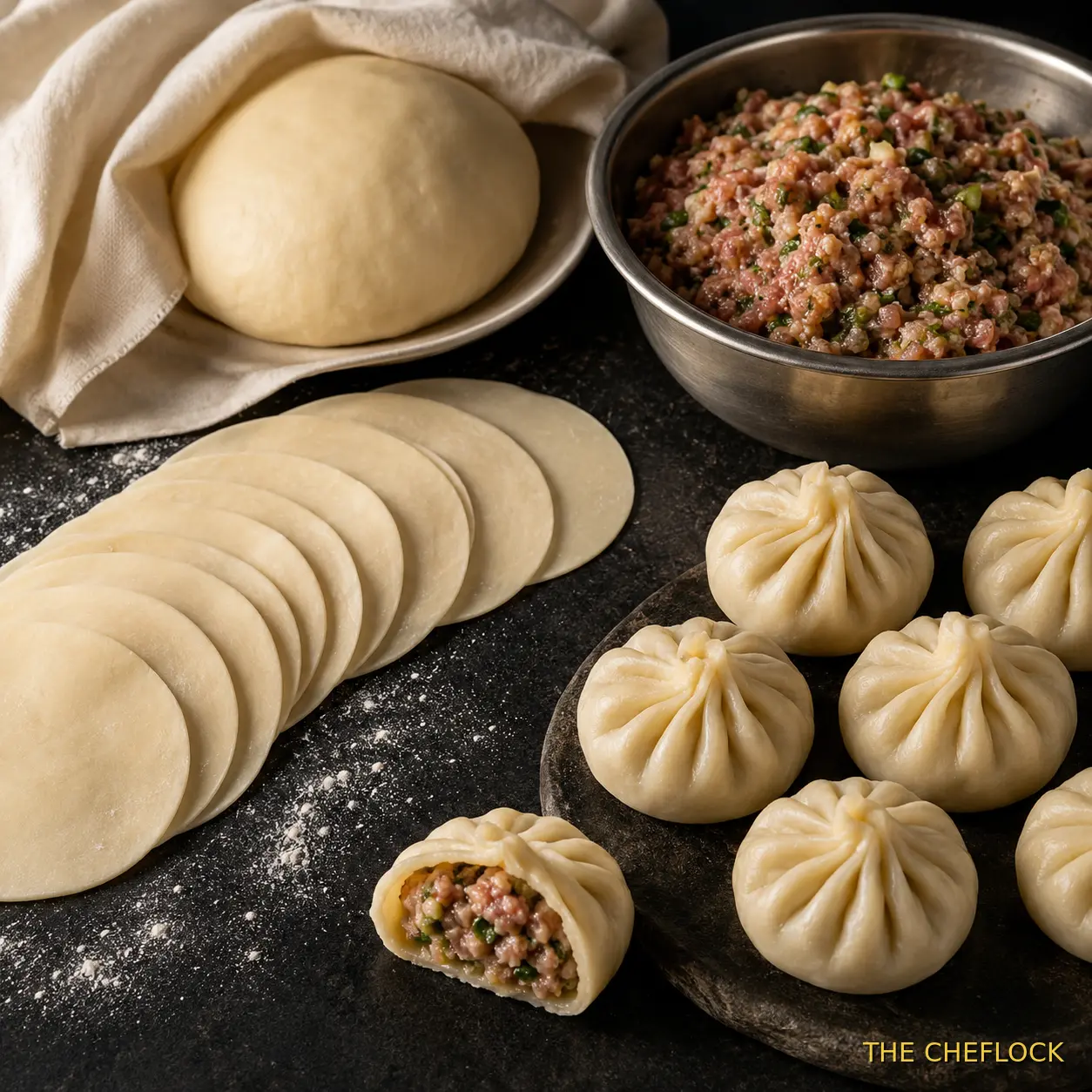
A good momo should have a thin, tender wrapper, a secure pleat and a moist, well-seasoned centre. When momos crack, leak or become heavy, the problem is usually not one mysterious ingredient. It is the relationship between flour hydration, resting, rolling, filling temperature, portion size and steam.
A dependable dough framework
Begin with plain wheat flour, water and a small amount of salt. Flour absorption varies, so add most of the water first and reserve a little for adjustment. The target is a medium-firm dough: firm enough to hold a pleat, but supple enough to roll without cracking.
- Mix until no dry flour remains.
- Knead until the surface becomes smooth and the dough springs back slowly.
- Cover completely and rest for 20–30 minutes.
- Divide into equal portions and keep every unused piece covered.
Resting is not optional. It allows moisture to distribute and gluten tension to relax, making thin rolling possible without excessive force.
Wrapper thickness and shape
Roll from the centre outward while rotating the disc. Keep the centre slightly stronger and the edge thinner; overlapping pleats otherwise create a thick raw-tasting crown. Aim for consistent diameter so filling portions remain predictable.
| Symptom | Likely cause | Correction |
|---|---|---|
| Cracked edge | Dry dough or uncovered wrappers | Add minimal water next batch; cover immediately |
| Wrapper shrinks | Insufficient rest | Rest covered for another 10 minutes |
| Sticky disc | Excess water or flour used too late | Use a light dusting and improve initial hydration |
| Heavy pleat | Edge rolled too thick | Thin the outer 1–2 cm |
Building a juicy filling
For meat momos, a little natural fat and finely cut aromatic vegetables create moisture. Very lean meat tends to cook dry. Mix minced meat with onion or spring onion, ginger, garlic, coriander and measured seasoning while cold. Stir in one direction only until the mixture becomes lightly cohesive; aggressive prolonged mixing can make the cooked filling rubbery.
Vegetable fillings need moisture control. Salt draws water from cabbage and other vegetables, so either salt and squeeze them before mixing or season immediately before filling. Cool any pre-cooked mushroom, paneer or vegetable mixture completely.
Food-safety discipline
- Keep raw meat filling refrigerated until needed.
- Work in small batches and return unused filling to the refrigerator.
- Use separate utensils and boards for raw meat.
- Wash hands after handling raw filling and before touching cooked momos.
- Cook poultry filling to a safe internal temperature appropriate to local food-safety guidance; verify with a thermometer when possible.
Filling and pleating
Place filling in the centre, leaving a clean border. Filling smeared onto the rim prevents a reliable seal. Lift the wrapper without stretching the centre, then form small even pleats. Press each pleat firmly against the previous fold and close the crown.
More filling is not automatically better. Overfilling causes leakage and slows heat penetration; underfilling creates a dough-heavy momo. Weigh the first several pieces until your hand learns a repeatable ratio.
Steaming correctly
- Bring the steamer to a full, steady steam before loading.
- Lightly oil or line the tray and leave space between pieces.
- Place similarly sized momos together.
- Close the lid promptly and avoid repeatedly opening it.
- Cook until the wrapper is set and the centre is safely cooked.
Timing depends on wrapper thickness, filling type, momo size and steamer load. A clock supports judgment; it does not replace checking the product.
Troubleshooting finished momos
They leak in the steamer
The rim may be oily or wet, the wrapper may be torn, or the momo may be overfilled. Keep the sealing border clean and inspect the base before steaming.
The wrapper is tough
Common causes are dry dough, thick rolling, too much bench flour or prolonged steaming. Correct the dough before adding oil, which can make sealing harder.
The filling is dry
Use meat with suitable fat, cut onion finely, avoid squeezing all moisture from the mixture and stop cooking once safe doneness is reached.
The base sticks
Oil or line the tray lightly and allow cooked momos to rest for one minute before lifting with a thin spatula.
The momo collapses
A wet filling, weak centre or delayed steaming can soften the base. Fill immediately before cooking and keep the centre slightly thicker than the edge.
Freezing without damage
Arrange uncooked momos separately on a lined tray and freeze until firm. Transfer them to a labelled airtight container only after they are individually frozen. Steam from frozen rather than thawing them into a wet, fragile state; allow extra cooking time and verify the centre.
Frequently asked questions
Should momo dough contain oil?
It can, but it is not essential. A well-hydrated, rested flour-and-water dough produces an excellent wrapper and seals cleanly.
Why do my circles keep shrinking?
The gluten is still tense. Cover and rest the dough longer.
Can I prepare wrappers hours ahead?
Freshly rolled wrappers dry and may stick when stacked. It is more reliable to rest portioned dough and roll in manageable batches.
How do I keep every momo the same size?
Weigh dough and filling portions during practice. Consistent size improves appearance and cooking reliability.
Chef’s note: Momo quality comes from repetition with control. Record flour, water, portion weight and cooking time, then adjust only one variable at a time.